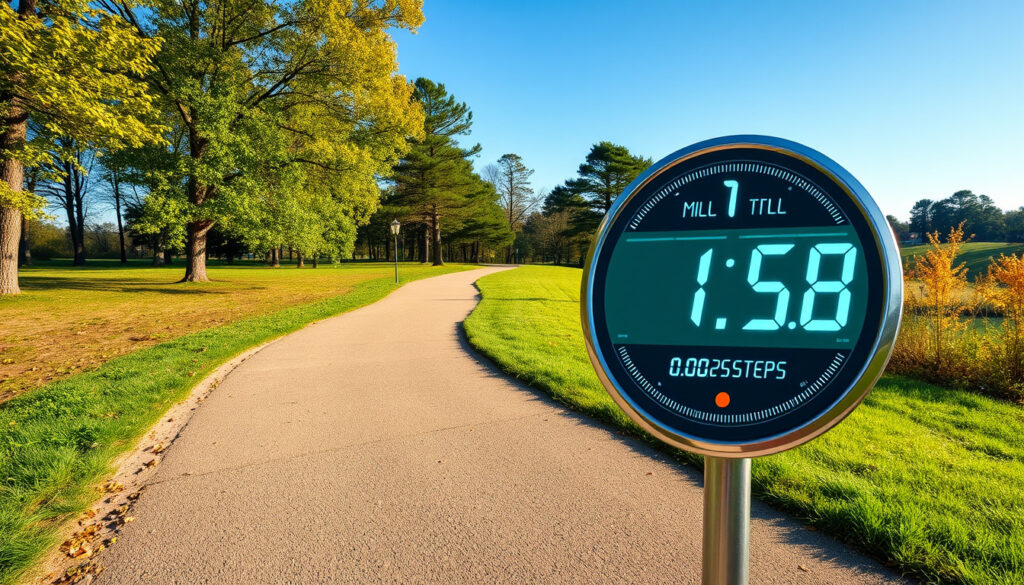
How Many Steps Is a Mile? Averages, Calculator & Factors
The popular 10,000-step goal does not translate to the same distance for everyone. How many steps in a mile depends on your stride length—and that varies significantly with height and gender, meaning two people walking identical steps can log different distances on their trackers.
Average walking steps per mile: 2,000-2,500 · Running steps per mile: 1,500 · 10,000 steps distance: 5 miles
Quick snapshot
- A mile is 63,360 inches — the fixed reference point for all conversions (Omni Calculator)
- The average person takes 2,000–2,500 steps per mile when walking (Omni Calculator)
- Your exact count without measuring your personal stride length
- How hills or rough terrain shift the numbers
- Running coach Jack Daniels identified the 180-steps-per-minute cadence benchmark at the 1984 Olympic Games (Runner’s World)
- That benchmark still anchors modern running performance analysis today (Runner’s World)
- Use your own stride length to personalize any steps-to-miles conversion
- Apply different formulas for walking versus running
| Measurement | Value |
|---|---|
| Standard mile length | 5,280 feet or 63,360 inches |
| Average stride length (walking) | 2.2–2.5 feet |
| Steps for 1 mile walking | 2,000–2,500 |
| Steps for 1 mile running | 1,500 |
How many miles is 10,000 steps of walking?
Ten thousand steps sounds like a round number, but the distance it covers depends on one key variable: your stride length. For the average person, 10,000 steps translates to approximately 4.4–5 miles (The Calculator Site). That range isn’t sloppiness — it’s a reflection of real variation between taller and shorter walkers.
Factors affecting 10,000 steps distance
Height is the primary driver of stride length, which in turn determines how far you travel per step. The relationship is straightforward: an average person’s stride equals roughly 43% of their height (Omni Calculator). A 5’9″ man with a stride around 2.5 feet will cover more ground per step than a 5’2″ woman averaging 2.2 feet. That’s why a man walking 10,000 steps may log close to 5 miles while a woman of the same fitness level might come in nearer to 4.4 miles.
10,000 steps for women
Women average 2,400 steps per mile compared to the general population’s 2,000–2,500 range (Omni Calculator). This means 10,000 steps lands at roughly 4.2 miles for a woman of average height. The difference stems from a shorter average stride — not lower fitness, but simpler biomechanics tied to height. A 5’4″ woman walking 20,000 steps at a regular pace covers about 8.6 miles, according to The Calculator Site (The Calculator Site). The implication is straightforward: if you’re a woman using a fitness tracker calibrated for the “average” population, your actual mileage may be lower than what the device reports.
How many steps is a 30 minute walk?
A 30-minute walk at a comfortable pace typically yields 2,000–3,000 steps, covering about 1.5–2 miles depending on your speed. At an average walking pace of 3 mph, you can expect roughly 2,252 steps per mile (The Calculator Site). Pick up the pace to a brisk 4 mph, and that same mile takes only 1,935 steps because longer strides mean fewer total footfalls.
Pace and distance variations
The relationship between pace and step count is inverse but not linear. Doubling your speed doesn’t halve your steps per mile — it reduces them by roughly 15–20% because running and fast walking naturally extend your stride. Recreational runners typically operate at a cadence of 140 to 170 steps per minute, while faster runners push toward 180 steps per minute (Runner’s World). The pattern is clear: faster cadence and longer stride together compress the steps-per-mile ratio.
Calories burned in 30 minutes
A 30-minute walk burns roughly 100–200 calories for most adults, with the exact number depending on weight and pace. Brisk walkers burn more per minute simply because they cover more distance in the same time. While step count matters for activity goals, calories burned depend more on intensity than total steps — a point many trackers gloss over.
How many steps is a mile for a woman?
Women average 2,400 steps per mile based on an average stride length of 2.2 feet, according to calculations from Omni Calculator (Omni Calculator). Men, with an average stride of 2.5 feet, need only about 2,112 steps to cover the same mile. That gap of roughly 300 steps compounds over distance: a 5-mile walk for a man might require 10,560 steps; for a woman, the same route could demand closer to 12,000.
Women vs men stride differences
The stride length difference between sexes is rooted in anatomy — overall height averages and pelvic structure — not fitness level. During running, males average a step length of 1.07 meters while females average 0.91 meters (Health HP). Interestingly, both sexes averaged 164 steps per minute cadence during running in the same study, meaning the stride length gap persists regardless of how quickly they move their feet.
Height impact like 5’2″
A 5’2″ woman with a stride around 2.2 feet needs roughly 2,400 steps per mile. At that height, the average stride-to-height ratio of 0.43 holds fairly well. Smaller variations exist — fitness, terrain, and walking speed all nudge stride length up or down — but height remains the strongest predictor. What this means practically: a 5’2″ woman should expect her step tracker to over-report mileage compared to what her route actually covers if it’s using population averages rather than her personal data.
Women generally need 200–300 more steps than men to walk a mile. Over a 10,000-step goal, that difference can translate to nearly a full mile of extra walking — a real consideration for anyone tracking daily activity targets.
How many steps is a mile running?
Running compresses the steps-per-mile count significantly. With longer strides and more dynamic movement, most runners cover a mile in roughly 1,500 steps — about 30% fewer than walking (Omni Calculator). Run fast enough, and elite athletes have been recorded at around 1,400 steps per mile (The Calculator Site).
Running vs walking stride
Stride length while running stretches to 5–7 feet compared to the 2.2–2.5 feet typical of walking. The difference isn’t just speed — it’s mechanics. A runner’s foot spends less time on the ground per step, and the leg extends further with each push-off. According to Runner’s World, stride length is the distance covered between where one foot hits the ground and the next time that same foot hits the ground again (Runner’s World). Cadence — the number of steps per minute — doubles your foot strikes relative to strides, which is why running coaches pay close attention to this metric.
Pace effects
Elite distance runners at the 1984 Olympic Games maintained a cadence of 180 foot strikes per minute or higher — a benchmark established by running coach Jack Daniels (Runner’s World). Recreational runners typically fall between 140 and 170 strikes per minute. To run faster, an athlete either covers more ground per stride, increases cadence, or combines both. The pattern is consistent: higher cadence and longer stride length each independently reduce steps per mile.
At 6 mph, running a mile takes about 1,672 steps. Jog that same pace, and the count rises to 1,951 steps per mile because the shorter stride of a jog doesn’t offset the slower speed efficiently.
Is 5,000 steps a mile?
No — 5,000 steps falls well short of a mile. For the average walker, 5,000 steps covers approximately 2.2 miles (ARAHR). That’s roughly half the popular 10,000-step daily goal. The reason is straightforward: if 2,000–2,500 steps equal one mile, then 5,000 steps lands at about 2–2.5 miles depending on your stride length.
How far is 5,000 steps?
Five thousand steps translates to a 20–25 minute walk at a comfortable pace — or about 1.5–2 miles. At an average walking speed of 3 mph, 1,000 steps equals roughly 0.4 miles, which means 5,000 steps lands at approximately 2 miles (The Calculator Site). A brisk walker at 4 mph might squeeze 0.5 miles out of every 1,000 steps, pushing 5,000 steps closer to 2.5 miles.
Steps in 5 miles
Walking 5 miles requires approximately 10,000–12,500 steps for most people. The range reflects gender and height differences: a 5’9″ man might manage 5 miles in 10,560 steps with his longer stride, while a 5’4″ woman could need 12,000 steps or more. Running the same 5 miles requires only about 7,500 steps due to the extended stride length and reduced ground contact time per step.
Confirmed facts
- A mile contains 63,360 inches — the fixed reference point for all conversions
- The average person takes 2,000–2,500 steps per mile when walking
- Men average roughly 2,112 steps per mile; women average about 2,400 steps per mile
- Running requires approximately 1,500 steps per mile
What’s unclear
- Your precise count without measuring your personal stride length
- How terrain — hills versus flat ground — affects the calculation
What the experts say
The average person’s stride length is approximately 2.5 feet long. That means it takes a little over 2,000 steps to walk one mile.
— University of Iowa Student Health
If you’re maintaining the same pace but running with a shortened stride length, you’ll increase your cadence because you’ll be taking more steps per minute. If you lengthen your stride, you’ll be taking fewer steps per minute at the same pace.
— Sperl, running performance expert
For anyone tracking steps or training toward a distance goal, the math is simple once you know your stride length. The formula: divide your step count by your pace-appropriate steps-per-mile — or calculate your personal stride by measuring a known distance and dividing by your step count over that stretch. No expensive gear required, just a tape measure and a flat stretch of sidewalk.
Related reading: How Many Cups Are in a Pint? US Charts & Conversions · How Many Cups Are in a Gallon – US and Imperial Conversions
healthline.com, inchcalculator.com, studenthealth.uiowa.edu, lowellrunning.com
Averages fall between 2,000 and 2,500 steps per mile, though breakdown by height, gender, pace reveals how height, gender, and pace create further variations.
Frequently asked questions
What does walking 10,000 steps do for your health?
Walking 10,000 steps daily — roughly 4.4–5 miles for most people — can improve cardiovascular health, boost mood, and support weight management. Research links consistent walking to lower blood pressure, better cholesterol levels, and reduced risk of chronic diseases.
Is a 10 minute walk a mile?
At an average walking pace of 3 mph, a 10-minute walk covers about half a mile. Brisk walkers at 4 mph may reach 0.6–0.7 miles in that time. Your exact distance depends on your pace and stride length.
Can I lose weight by just walking 10,000 steps a day?
Walking 10,000 steps burns roughly 300–500 extra calories daily depending on your weight and pace. Over time, that consistent deficit can support gradual weight loss — especially when combined with balanced nutrition.
How long should it take a 60 year old to walk a mile?
Most healthy adults over 60 walk a mile in 18–22 minutes at an easy pace. Faster walkers may complete it in 15–17 minutes. Individual fitness level, joint health, and terrain all influence the time.
What is the 3 3 3 rule for walking?
The 3-3-3 rule is a simple activity framework: walk 3 times per week, for at least 3 miles each session, at a pace you can maintain for 3 or more hours total weekly. It’s designed for sustainable, moderate exercise that builds endurance without overexertion.
Can I lose weight by walking 30 minutes a day?
Walking 30 minutes daily burns approximately 100–200 extra calories depending on your weight and speed. While modest alone, combined with dietary changes, this consistent activity can contribute to meaningful weight loss over several months.
How far should a 70 year old woman walk each day?
Health guidelines typically recommend 150 minutes of moderate activity weekly for older adults. A reasonable daily target is 3,000–5,000 steps (1.5–2.5 miles), adjusted based on individual health, mobility, and fitness background.
How many steps in 5 miles?
Walking 5 miles requires roughly 10,000–12,500 steps for most people. Running the same distance needs about 7,500 steps due to longer strides. The exact number varies based on your personal stride length and pace.
More related posts
 Why Am I Bleeding After Sex? Common Causes & When to Worry
 LFG Meaning in Text: Let’s Go or Looking for Group
 Adria Arjona Movies and TV Shows – Complete Filmography 2024
 How Many People Attended the Military Parade? Army 250th Facts
 Jason Aldean Tour 2025: Full Throttle Set List & Dates
 Dallas Mavericks vs Oklahoma City Thunder Match Player Stats
 How to Prepare for an Interview: 5 Steps & Common Questions
 Think and Grow Rich by Napoleon Hill: 13 Principles for Success
