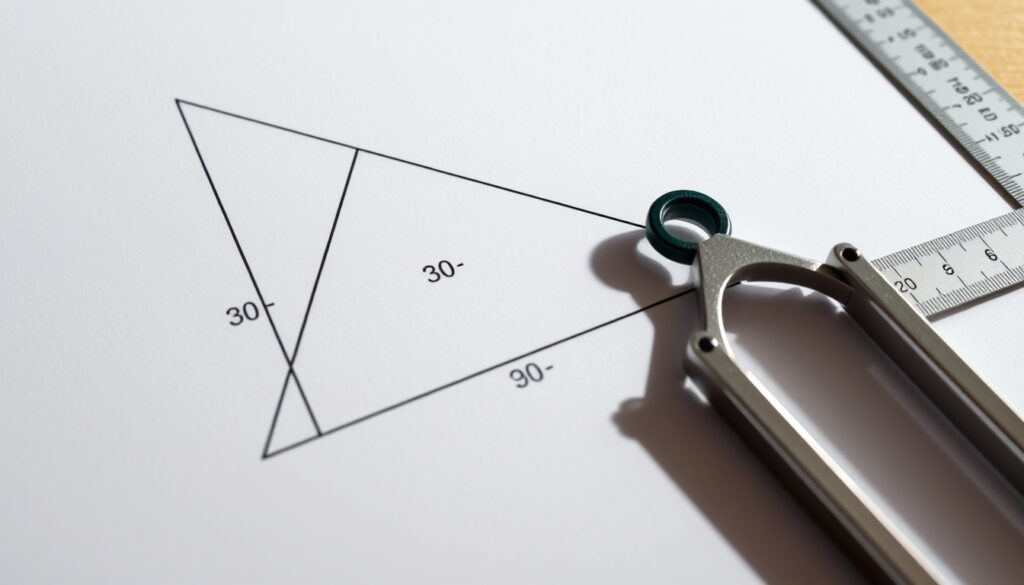
30 60 90 Triangle Rules: Side Ratio, Formula & Examples
Few right triangles appear as often as the 30-60-90. It’s the one you meet in geometry homework, on the SAT, and in construction blueprints — and once you learn its secret, you can figure out all three sides from a single number. That secret is a fixed side ratio of 1 : √3 : 2, a pattern that makes calculations almost automatic.
Side ratio: 1 : √3 : 2 ·
Smallest angle: 30° ·
Second angle: 60° ·
Right angle: 90° ·
Origin: Half of an equilateral triangle
Quick snapshot
- A 30-60-90 triangle has the fixed ratio 1 : √3 : 2 (PrepScholar (test-prep resource)).
- The hypotenuse is always twice the shortest leg (Tutors.com (online tutoring)).
- It is a special right triangle (Tutors.com).
- The exact historical derivation of the 30-60-90 concept is not universally documented (Wolfram MathWorld (mathematical reference)).
- Short leg = x, long leg = x√3, hypotenuse = 2x (Tutors.com).
- If you know one side, you can find the other two (Study.com (educational resource)).
- Practice with these rules on real test problems to build speed.
- Watch for the common mistake of mixing up the short leg and long leg.
Five properties, one pattern: the 30-60-90 triangle’s angles and side lengths are strictly linked.
| Property | Value |
|---|---|
| Angle measures | 30°, 60°, 90° |
| Side length ratio | 1 : √3 : 2 |
| Hypotenuse length | 2 × short leg |
| Long leg length | √3 × short leg |
| Short leg length | hypotenuse / 2 |
| Long leg from hypotenuse | hypotenuse × √3 / 2 |
| Origin | Half of an equilateral triangle |
The implication: once you identify the short leg (opposite 30°), the other two sides are simple multiplications. No guesswork needed.
What is the Rule for 30‑60‑90 Triangles?
Side length ratio
- The shortest side is opposite the 30° angle (PrepScholar).
- The hypotenuse is twice the shortest side (Tutors.com).
- The longer leg is √3 times the shortest side (Khan Academy (non-profit educational platform)).
The rule is neat: short leg = x, long leg = x√3, hypotenuse = 2x. That’s the whole formula.
Derivation from equilateral triangle
Imagine an equilateral triangle where every side is the same length. Cut it along the altitude from one vertex to the opposite side. You get two right triangles — each one has angles 30°, 60°, and 90° (Wolfram MathWorld). The altitude splits the base into two equal halves, so the short leg of the 30-60-90 triangle is exactly half the original side. That half becomes the short leg, and the altitude becomes the long leg (√3 times half). This visual trick is why the ratio is so consistent.
For students, remembering that a 30-60-90 triangle is simply half an equilateral triangle turns an abstract ratio into something you can draw in two seconds. That visual anchor cuts down on errors.
The pattern: the ratio holds regardless of the triangle’s size, making it one of the most reliable shortcuts in geometry.
How to Find the Sides of a 30‑60‑90 Triangle?
Calculate the short leg
- Given the hypotenuse: divide by 2 (Omni Calculator (online calculator tool)).
- Given the long leg: divide by √3 (Study.com).
Calculate the long leg
- Given the short leg: multiply by √3 (Study.com).
- Given the hypotenuse: multiply by √3/2 (Omni Calculator).
Calculate the hypotenuse
- Given the short leg: multiply by 2 (Tutors.com).
- Given the long leg: multiply by 2/√3 (Khan Academy).
These three rules form a complete toolkit. With any one side, you can solve the other two in a single step.
Step‑by‑step example
- Identify what you know. Suppose the short leg is 5 cm.
- Find the hypotenuse. 5 × 2 = 10 cm.
- Find the long leg. 5 × √3 ≈ 8.66 cm.
- Check with the Pythagorean theorem. 5² + (5√3)² = 25 + 75 = 100 = 10². Consistent.
The pattern: once you have the short leg, the rest is multiplication. No square roots needed except the √3.
A common slip: treating the long leg as double the short leg instead of “short leg times √3.” Double is only for the hypotenuse. Test yourself with a simple problem — 3–4–5 triples don’t fit; the 30-60-90 always uses √3.
The catch: mixing up the legs is the most frequent error, but the ratio itself prevents it if you always anchor on the short leg first.
Is 30‑60‑90 a Pythagorean Triple?
Definition of Pythagorean triple
A Pythagorean triple consists of three positive integers a, b, c that satisfy a² + b² = c² (Wikipedia (open-source encyclopedia)). Since the sides of a 30-60-90 triangle are in the ratio 1 : √3 : 2, and √3 is irrational, the side lengths can never all be integers.
Common Pythagorean triples
- 3‑4‑5
- 5‑12‑13
- 8‑15‑17
These are integer triples. A 30-60-90 triangle, by contrast, always contains the irrational number √3, so it is not a Pythagorean triple.
The catch: many students mistakenly treat the side lengths as integers, but the 30-60-90 is a special right triangle with a fixed ratio, not a Pythagorean triple. They are different categories.
The implication: understanding this distinction prevents a common category error that can throw off entire problem sets.
How Can I Easily Remember the 30‑60‑90 Triangle Rules?
Mnemonic devices
- “Short leg opposite 30, hypotenuse is double.” Repeat it like a chant.
- “1‑√3‑2” — memorize the ratio order: short leg, long leg, hypotenuse.
Visual memory aids
Always start by drawing an equilateral triangle and cutting it in half. The short leg is half the base, the hypotenuse is the original side, and the long leg is the altitude (Khan Academy). Once you see it, the numbers stick.
Another trick: color‑code the sides. Short leg = blue, long leg = green (√3 times blue), hypotenuse = red (double blue).
The trade‑off: memory aids are fast but can break if you don’t practice with actual problems. Use them as a warm‑up, then test yourself.
Relying on mnemonics alone without understanding the derivation from the equilateral triangle. When the problem gives you the long leg first, the “double” reflex leads to the wrong answer — you must divide by √3, not multiply.
The pattern: the equilateral-half derivation is the most reliable anchor, because it explains why the ratio exists in the first place.
What is the Correct Formula for the Pythagorean Theorem?
Standard formula
For any right triangle, a² + b² = c², where c is the hypotenuse (Wolfram MathWorld).
Application in 30‑60‑90 triangles
Plug in the sides: short leg = x, long leg = x√3, hypotenuse = 2x.
Check: x² + (x√3)² = x² + 3x² = 4x² = (2x)². The ratio satisfies the theorem exactly (Khan Academy). This verification is useful when you want to confirm your work.
Why this matters: the Pythagorean theorem is universal, but the 30-60-90 ratio gives you a shortcut. You don’t have to solve for each side from scratch — you already know the pattern.
“A 30‑60‑90 triangle is a right triangle with angles of 30°, 60°, and 90°. The lengths of its sides are in the ratio 1 : √3 : 2.”
— Wolfram MathWorld (mathematical reference)
“Given the short leg, the hypotenuse is twice that length, and the long leg is √3 times the short leg.”
— Khan Academy (non-profit educational platform)
For anyone studying geometry or pre‑calculus, mastering the 30-60-90 triangle means cutting problem‑solving time in half. The rule is short, the derivation is visual, and the common mistakes — mixing up the legs or forgetting the √3 — are easy to avoid once you practice the half‑equilateral trick.
Confirmed facts
- 30-60-90 triangles have the side ratio 1:√3:2 (PrepScholar)
- The hypotenuse is twice the shortest leg (Tutors.com)
- These triangles are formed by halving an equilateral triangle (Wolfram MathWorld)
What’s unclear
- The exact historical derivation of the 30-60-90 triangle concept is not universally documented (Wolfram MathWorld)
For students tackling geometry tests, the choice is clear: invest ten minutes in the equilateral‑half trick, and the 30-60-90 triangle becomes one of the fastest problems you’ll solve — or you’ll waste time recalculating the ratio every time.
Understanding the side ratio 1:√3:2 is essential, and you can explore more about 30-60-90 triangle rules in this comprehensive guide.
Frequently asked questions
How do you solve a 30-60-90 triangle?
Identify one side and use the ratio: short leg × 2 = hypotenuse, short leg × √3 = long leg. If given the hypotenuse, divide by 2 to get the short leg. If given the long leg, divide by √3 to get the short leg (Tutors.com).
What is the length of the hypotenuse in a 30-60-90 triangle?
The hypotenuse is twice the length of the short leg (the side opposite the 30° angle) (PrepScholar).
Can the sides of a 30-60-90 triangle be integers?
No, because the ratio includes √3, an irrational number. The side lengths are multiples of 1, √3, and 2, so they can never all be integers (Wikipedia).
Why is a 30-60-90 triangle special?
It’s a special right triangle because its side lengths follow a fixed, predictable ratio, making it easy to solve without the Pythagorean theorem (Tutors.com).
How do you find the short leg of a 30-60-90 triangle?
If given the hypotenuse, divide by 2. If given the long leg, divide by √3 (Study.com).
Is a 30-60-90 triangle the same as a right triangle?
Yes, it’s a specific type of right triangle. All 30-60-90 triangles are right triangles, but not all right triangles are 30-60-90 (Khan Academy).
What are the side lengths of a 30-60-90 triangle if the short leg is 5?
Short leg = 5, long leg = 5√3 ≈ 8.66, hypotenuse = 10 (Omni Calculator).
Can the Pythagorean theorem be used on a 30-60-90 triangle?
Yes, it works for any right triangle. Plugging in 1, √3, 2 gives 1² + (√3)² = 1 + 3 = 4 = 2² (Wolfram MathWorld).
Related reading · How to Calculate Percentage: Formula, Steps & Examples · 5 cm to Inches: Conversion, Size Comparisons & Visuals
More related posts
 Best Baby Car Seats 2026: Top Rated and Safest Picks
 Things to Do in Nashville: Must-Sees & Itineraries
 What Is Spinal Stenosis – Symptoms, Causes, Treatment Guide
 Vanna White Net Worth: Salary, Husband, and Age in 2025
 Catherine O’Hara Cause of Death: How Did She Die
 Castle in the Sky: The 1986 Ghibli Classic Explained
 The Last of Us Cast: Season 2 Guide & Key Additions
 Carnivore Diet Meal Plan: What to Eat & Risks
