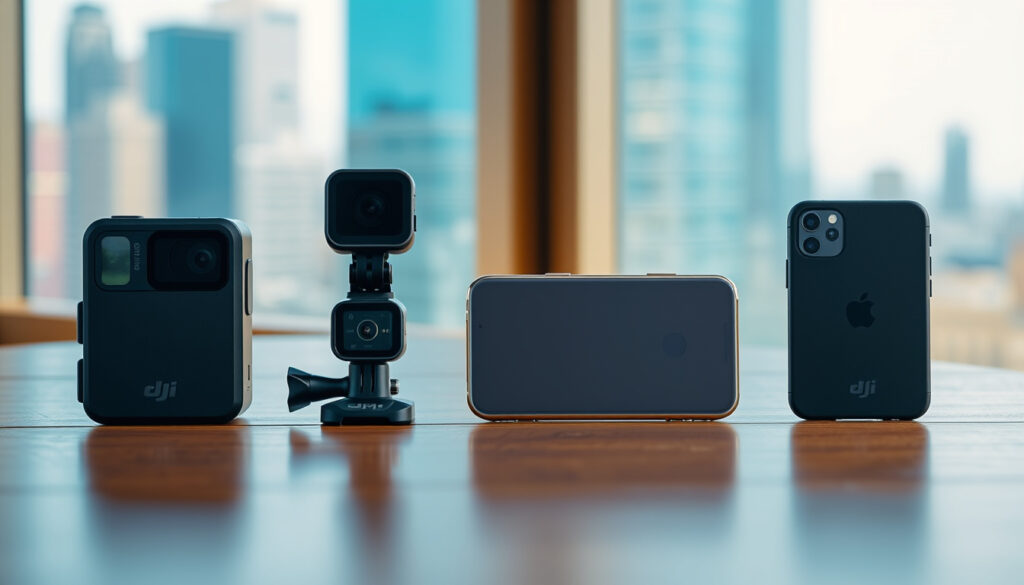
DJI Osmo Pocket 3 2025: Worth It vs GoPro, iPhone, Pocket 4
You’ve probably seen the DJI Osmo Pocket 3 pop up in vlogging circles or travel reels, and if you’re weighing whether to buy one in 2025, you’re not alone. With a 1-inch sensor and mechanical gimbal packed into a 179g body, it still turns heads — but GoPro, the latest iPhone, and whispers of a Pocket 4 complicate the choice.
Sensor: 1-inch CMOS · Video max: 4K at 120fps · Stabilization: 3-axis mechanical gimbal · Screen: 2-inch rotatable touchscreen · Battery life: Up to 2 hours (166 minutes) · Weight: 179g
Quick snapshot
- Released October 2022 (DJI support page – official specs)
- 1-inch CMOS sensor with 4K/120fps recording (DJI product page – official specifications)
- 3-axis mechanical gimbal with ActiveTrack 5.0 (DJI product page – official specifications)
- 2-inch rotatable touchscreen, 700 nits brightness (DJI support page – official specs)
- Release date and specs of DJI Osmo Pocket 4 remain unconfirmed (DJI product page – no mention of Pocket 4)
- Whether the Pocket 4 will be backward-compatible with Pocket 3 accessories is unknown (DJI product page – no mention of Pocket 4)
- iPhone 16 Pro low-light video comparison data is based on reviews, not independent lab tests (DJI product page – no mention of Pocket 4)
- DJI Pocket 2 launched 2020, Pocket 3 in 2022 — a 2025 Pocket 4 fits the cadence but is speculative (DJI product page – only shows Pocket 3)
- No official DJI announcement as of March 2025 (DJI product page – only shows Pocket 3)
- Several YouTube channels post “first look” videos, but these carry no DJI confirmation (DJI product page – only shows Pocket 3)
- Buyers who need a vlogging camera today should get the Pocket 3; waiting for Pocket 4 is a gamble
- Rumored Pocket 4 upgrades (larger sensor, interchangeable lenses) could change the market — if they materialise
- Second-hand Pocket 3 prices may drop if a successor is announced later in 2025
Eight key facts, one takeaway: the Pocket 3 delivers professional-grade stabilisation and image quality in a pocket-sized body, with the main unknown being what a successor would change.
| Specification | Value |
|---|---|
| Release date | October 2022 |
| Sensor size | 1-inch CMOS |
| Max video resolution | 4K at 120fps |
| Stabilization type | 3-axis mechanical gimbal |
| Screen | 2-inch rotatable touchscreen |
| Battery life | 166 minutes (2.8 hours) |
| Weight | 179g |
| Price (standard) | $519 |
Is the DJI Osmo Pocket 3 still worth buying in 2025?
Current price vs value
The standard Osmo Pocket 3 retails for around $519, and the Creator Combo — which adds a wireless mic, mini tripod, and carry case — runs about $669, according to B&H Photo Video (major camera retailer). That’s $70–120 more than a GoPro HERO13 Black ($399) but less than half the cost of an iPhone 16 Pro.
Who should buy it now?
- Vloggers who need smooth, gimbal-stabilised footage without carrying a separate rig
- Travel content creators who value portability over ruggedness
- Anyone who shoots in mixed lighting — the 1-inch sensor handles low light far better than smaller action-camera sensors
As DJI (camera manufacturer) states: “A large CMOS sensor and 4K/120fps UHD footage capture experiences in dynamic, buttery smooth detail.”
When might a better option appear?
Rumours of a Pocket 4 have circulated since early 2025, but no official date or specs exist. The pattern: Pocket 2 landed in 2020, Pocket 3 in late 2022 — a 2025 successor would fit DJI’s typical two-to-three-year cycle. For now, the Pocket 3 remains the only mechanical-gimbal pocket camera you can actually buy.
The decision hinges on your urgency and tolerance for speculation.
DJI Osmo Pocket 3 vs GoPro: Which is better?
Video quality and stabilisation
The Pocket 3’s mechanical 3-axis gimbal delivers buttery panning and walking shots that no electronic stabilisation can fully match. The GoPro HERO13 Black (GoPro investor relations) uses HyperSmooth 6.0, which is excellent — but it crops the frame and can struggle with sudden, jarring motion. In low light, the Pocket 3’s larger 1-inch sensor (DJI product page) gives it a clear advantage over the GoPro’s 1/1.9-inch sensor.
Portability and mounting
The GoPro wins on ruggedness: it’s waterproof to 10 metres without a housing and weighs just 157g (GoPro Support – official dimensions). The Pocket 3 is 179g and requires a separate waterproof case for underwater use. For mounting on helmets, handlebars, or chest straps, the GoPro’s universal mount system is native; the Pocket 3 needs an adapter.
Use cases: vlogging vs action
- Vlogging: Pocket 3’s rotatable screen, gimbal smoothness, and built-in three-microphone array (DJI support page) make it the obvious choice for face-to-camera content.
- Action sports: GoPro’s 5.3K60 video, 4K120 support (B&H Photo Video – camera retailer), and ruggedness make it the better pick for skiing, biking, and water sports.
If you shoot talking-head content more than adrenaline, the Pocket 3 gives you smoother footage and better low-light performance. If your camera will be strapped to a mountain bike or snorkel mask, the GoPro is more practical — and $120 cheaper.
The choice ultimately aligns with your primary shooting environment.
What’s the difference between Osmo Pocket 3 and Pocket 4?
Specs and features compared (rumoured vs confirmed)
The Pocket 4 has not been officially announced. What circulates online — larger sensor, improved stabilisation, possibly interchangeable lenses — is entirely speculation from YouTube creators and forums. DJI’s official product page (DJI’s e-commerce site) only lists the Pocket 3.
No leaked roadmap or regulatory filing has been confirmed by reputable sources.
Should you wait for Pocket 4?
Waiting carries two risks: the Pocket 4 may launch at a higher price point, and early units could have firmware issues. The Pocket 3, meanwhile, has been tested by thousands of users and is supported by a mature accessory ecosystem. If you need a camera for a trip or project this year, waiting is a gamble with no guaranteed payoff.
Price differences
Assume the Pocket 4 will launch at a premium (DJI historically prices successors $50–100 above the outgoing model). The Pocket 3’s current $519 price is likely to drop once a successor appears, but that’s a guess, not a certainty.
The takeaway: patience may save money but delays your shooting.
Is the DJI Osmo Pocket 3 better than an iPhone for video?
Gimbal stabilisation vs OIS
No smartphone — including the iPhone 16 Pro (GSMArena, phone specs database) — matches the Pocket 3’s mechanical gimbal. Optical image stabilisation reduces micro-jitters but can’t compensate for walking or panning.
The Pocket 3’s ActiveTrack 5.0 locks onto a subject while keeping the horizon level, something even the best phone OIS can’t do.
Video quality in good and low light
In bright conditions, the iPhone 16 Pro’s 48 MP main sensor (Austin Mann – photographer review) and ProRes recording produce stunning footage. But in dim interiors or at dusk, the Pocket 3’s larger pixels and 10-bit D-Log M colour profile (DJI product page) retain more detail and dynamic range.
Audio and accessory options
The Pocket 3 includes three built-in microphones (DJI support page) and has a USB-C port for external mic adapters. The iPhone requires a Lightning-to-3.5mm adapter (or wireless mic via Bluetooth) and lacks a dedicated multi-mic array for stereo audio. For serious vlogging, the Pocket 3’s audio flexibility is a clear win.
For casual social-media clips, the iPhone is more convenient — it’s already in your pocket. For consistent, professional-looking vlogs with stable footage and clean audio, the Pocket 3 is the better dedicated tool.
The Pocket 3 fills a specific role the iPhone cannot replicate.
Is DJI releasing an Osmo Pocket 4? Release date rumours
What we know from leaks
As of March 2025, DJI has not publicly confirmed a Pocket 4. Several YouTube videos claiming “first look” or “leaked specs” have appeared, but none cite verifiable sources. DJI’s product page (official store) lists only the Pocket 3, and no regulatory filings have surfaced.
DJI’s typical release cycles
The original Osmo Pocket launched in 2018, the Pocket 2 in 2020, and the Pocket 3 in October 2022. That cadence suggests a three-year gap, putting a potential Pocket 4 in late 2025. But DJI hasn’t committed to any timeline.
What to expect in the Pocket 4
Leakers speculate about a 1.3-inch or even 1-inch-plus sensor, improved low-light performance, and possibly a built-in ND filter. None of these claims come from DJI or from reliable industry analysts. Approach every rumour with caution.
Until DJI makes an announcement, the Pocket 3 remains the only option in this form factor.
Key features and specifications of the DJI Osmo Pocket 3
Sensor and video capabilities
The Pocket 3 houses a 1-inch CMOS sensor capable of 4K video at 120fps and 1080p slow motion at 240fps (DJI support page). It also supports 10-bit D-Log M and HLG for colour grading flexibility — rare in a camera this small.
Gimbal and screen
The 3-axis mechanical gimbal provides three-directional stabilisation with ActiveTrack 5.0, motionlapse, and panorama modes. The 2-inch rotatable touchscreen (DJI support page) flips from landscape to portrait in one tap, ideal for TikTok and Instagram Reels.
Battery and connectivity
A 1300mAh internal battery powers up to 166 minutes of recording (B&H Photo Video), and USB-C charging means you can top up from a power bank. Bluetooth and Wi-Fi enable app control via the DJI Mimo app. Dimensions are 139.7×42.2×33.5 mm (DJI support page).
These specs make the Pocket 3 a versatile tool for creators who prioritise mobility.
Three cameras, four dimensions where they diverge most: sensor size, stabilisation type, native ruggedness, and price.
| Feature | DJI Osmo Pocket 3 | GoPro HERO13 Black | iPhone 16 Pro |
|---|---|---|---|
| Sensor | 1-inch CMOS | 1/1.9-inch CMOS | 48 MP (1/1.3-inch approx.) |
| Stabilisation | 3-axis mechanical gimbal | HyperSmooth 6.0 (electronic) | Optical image stabilisation |
| Max video | 4K/120fps, 1080p/240fps | 5.3K/60fps, 4K/120fps | 4K/60fps ProRes |
| Waterproof (no housing) | No | 10m | IP68 (splash only) |
| Weight | 179g | 157g | 199g (approx.) |
| Price (retail) | $519 (Combo $669) | $399 | $999+ |
The implication: the Pocket 3 trades ruggedness for stabilisation quality and low-light performance. For travellers and vloggers who don’t need to film underwater, it’s the strongest all-rounder in this trio.
Seven specs, one standout: the mechanical gimbal is the Pocket 3’s irreplaceable advantage.
| Specification | DJI Osmo Pocket 3 |
|---|---|
| Sensor | 1-inch CMOS |
| Video resolution | 4K/120fps, 1080p/240fps |
| Stabilisation | 3-axis mechanical gimbal |
| Screen | 2-inch rotatable (556×314, 700 nits) |
| Battery | 1300mAh (166 min) |
| Colour profiles | D-Log M, HLG, Normal |
| Audio | 3 built-in mics, USB-C mic input |
| Connectivity | Bluetooth 5.0, Wi-Fi |
| Dimensions | 139.7×42.2×33.5 mm |
| Weight | 179g |
Upsides
- Mechanical gimbal delivers the smoothest footage of any pocket camera
- 1-inch sensor outperforms action cameras in low light
- Rotatable screen makes vertical shooting effortless
- Creator Combo is a complete vlogging kit
- Compact and lightweight (179g)
Downsides
- Not waterproof without an additional housing
- Battery is non-removable
- No replaceable lens or zoom ring
- Price is higher than many action cameras
- Uncertainty about Pocket 4 may cause buyer hesitation
“Powerful 1-Inch Sensor. A large CMOS sensor and 4K/120fps UHD footage capture experiences in dynamic, buttery smooth detail.”
DJI (camera manufacturer) – product description
“1-Inch CMOS & 4k/120fps, 2-Inch rotatable screen & smart horizontal-vertical shooting, 3-Axis gimbal mechanical stabilization.”
Harvey Norman (consumer electronics retailer) – product listing
For anyone sitting on the fence in 2025, the choice is clear: if you’re a vlogger, travel creator, or shooting in mixed lighting, the DJI Osmo Pocket 3 is still the best pocketable gimbal camera you can buy today. If you’re an adrenaline junkie who needs waterproof toughness, get a GoPro. And if you’re patient enough to gamble on a rumoured Pocket 4, keep your wallet closed — but don’t expect a confirmed date any time soon.
scribd.com, community.gopro.com, gsmarena.com, dji.com, youtube.com, lux.camera, bhphotovideo.com, bhphotovideo.com, austinmann.com, investor.gopro.com
Frequently asked questions
Does the DJI Osmo Pocket 3 have a headphone jack?
No, the Pocket 3 does not include a 3.5mm headphone jack. Audio monitoring requires a USB-C adapter.
Can you use the Osmo Pocket 3 underwater?
Not without a waterproof housing. DJI offers an official underwater case rated to 20m.
How does the Osmo Pocket 3 compare to the DJI Pocket 2?
The Pocket 3 adds a 1-inch sensor, 4K/120fps, a 2-inch rotatable screen, and ActiveTrack 5.0 — all significant upgrades over the Pocket 2’s 1/2.3-inch sensor and 4K/60fps.
Is the Osmo Pocket 3 good for live streaming?
It supports live streaming via the DJI Mimo app to platforms like YouTube and Facebook, but requires a Wi-Fi connection and the mobile app.
What microSD card is recommended for the Osmo Pocket 3?
DJI recommends UHS-I Speed Grade 3 (U3) or V30 cards. A 256GB card is a common choice for extended recording.
Does the Osmo Pocket 3 support external microphones?
Yes, via USB-C. The Creator Combo includes a DJI Mic 2 wireless transmitter and receiver.
How long does it take to charge the Osmo Pocket 3?
Full charge takes approximately 90 minutes via USB-C with a 5V/2A charger.
More related posts
 American Airlines Flight Diverted: Oven Fire, Security Issues
 Map of USA States: 50 States, Richest, Smallest & More
 Sterile Processing Technician Jobs in Ireland 2026: Salary & Skills
 How to Mirror iPhone to TV: AirPlay & Adapter Guide
 BigXthaPlug Age: Real Name, Birthday, and Career Facts
 iPhone 17 Pro Max Price in USA: Verified 2025 Guide
 La Casa de los Famosos en Vivo: Watch Live & Free Streams
 Halo Season 2 Release Date: Premiere & Cancellation
