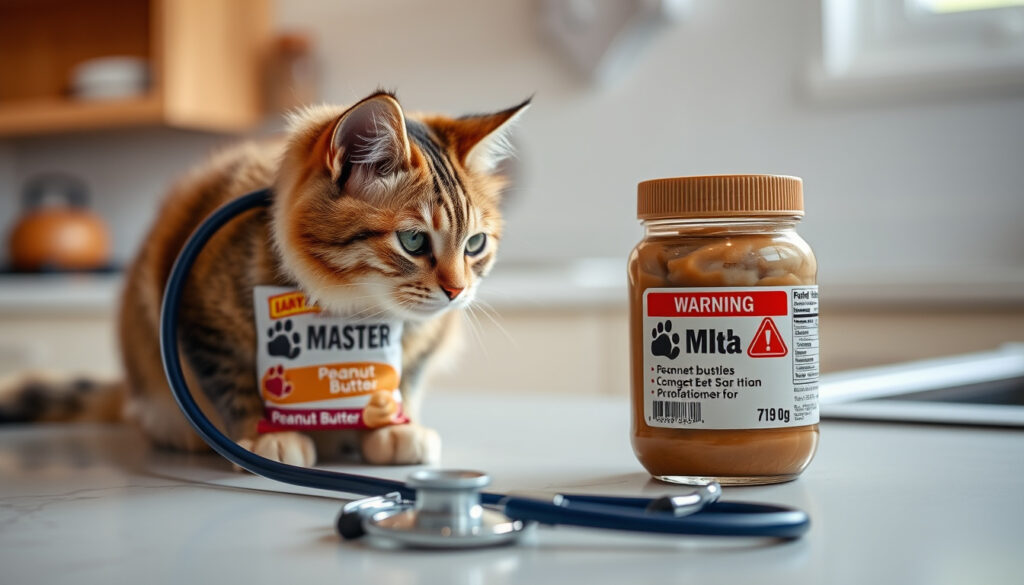
Can Cats Have Peanut Butter? Safety, Risks & Vet Advice
You’re standing in the kitchen, peanut butter jar in hand, and your cat is giving you that look. The one that says “I want what you’re eating.” It’s a small moment, but it raises a real question: can cats have peanut butter without getting hurt? The answer is more complicated than a simple yes or no, and a few hidden ingredients can turn a harmless lick into a trip to the vet.
Xylitol toxicity in cats: 10 mg/kg body weight can cause hypoglycemia ·
Peanut butter calories per teaspoon: Approximately 32 kcal ·
Ideal daily calorie for average cat: 200–300 kcal ·
Peanut butter safe dose (no xylitol): Less than ¼ teaspoon occasional ·
Silent killer urinary obstruction fatality rate: Up to 25% if untreated
Quick snapshot
- Xylitol‑free peanut butter is not acutely toxic in tiny amounts (Chewy pet‑care guide)
- Xylitol is dangerous to cats and dogs alike (Purina veterinary advice)
- High fat content can cause GI upset or pancreatitis (Can My Pet Eat)
- Exact toxic dose of xylitol for cats – few studies exist (Chewy precautionary note)
- Long‑term effects of occasional peanut butter on healthy cats (Chewy precautionary note)
- Whether cats are as sensitive to xylitol as dogs (MRFRS veterinary blog)
- No specific timeline data – treat as immediate risk if xylitol ingested (Purina symptom list)
- Vomiting can occur within 30 minutes of xylitol exposure (Purina symptom list)
- Check every label for xylitol, sorbitol, or added sweeteners (Hill’s Pet Nutrition warning)
- Switch to healthier treats like freeze‑dried chicken or banana (Hill’s Pet Nutrition warning)
The table below summarizes the key safety thresholds for peanut butter and xylitol in cats.
| Fact | Value |
|---|---|
| Toxicity level of peanut butter (xylitol free) | Low – non‑toxic in tiny amounts |
| Toxicity level of xylitol in cats | High – can cause rapid insulin release, hypoglycemia |
| Recommended treat frequency | Once per week maximum |
| Higher risk for obese or diabetic cats | Yes – avoid entirely |
Can cats have peanut butter?
The short answer: yes, but only if it’s xylitol‑free and given in a quantity smaller than a pea. Chewy’s pet‑care guide (a popular pet‑product retailer with a nutrition team) states that plain peanut butter without xylitol is not acutely toxic to cats in very small amounts. However, they stress that it offers no nutritional benefit for an obligate carnivore.
Is peanut butter toxic to cats?
- Without xylitol: Not acutely toxic. CatToxic, a specialized pet‑toxicology site, says plain peanut butter made from just peanuts is generally safe for cats in very small amounts.
- With xylitol: Potentially fatal. Purina’s veterinary experts warn that xylitol can cause vomiting, drooling, lethargy, balance problems, seizures, and possibly liver failure in a poisoned cat.
- High fat content: Can trigger gastrointestinal upset or pancreatitis. Can My Pet Eat, a consumer‑safety resource, notes that the sticky texture also creates a choking hazard.
How much peanut butter is safe for a cat?
If you decide to offer a taste, the serving size matters. Bella+Duke, a raw‑food brand for pets, frames peanut butter as acceptable only if it is xylitol‑free and given in small amounts infrequently. A safe dose is less than ¼ teaspoon (about the size of a pea), no more than once a week.
A cat that licks a smear of xylitol‑free peanut butter off a finger is unlikely to be harmed. But the same treat given daily or in larger portions crosses the line from safe to risky, especially for cats with existing health issues.
The implication: peanut butter is not a cat food. It’s a human indulgence that cats don’t need. The real value is in the label check – if you see xylitol, skip it entirely.
Does peanut butter kill cats?
In rare cases, yes. The danger comes from three separate mechanisms: xylitol poisoning, fat overload, and physical obstruction. Hill’s Pet Nutrition (a science‑based pet food company) advises that cat parents should avoid giving cats peanut butter because it can contain hazardous added ingredients.
Can peanut butter cause pancreatitis in cats?
Yes. The high fat content in peanut butter (about 16 g of fat per 2‑tablespoon serving) can overwhelm a cat’s digestive system. Can My Pet Eat lists pancreatitis as a concern, especially for cats prone to obesity or with a history of digestive issues. Symptoms include vomiting, abdominal pain, and lethargy.
What happens if a cat licks peanut butter?
If the peanut butter is xylitol‑free, a single lick usually causes nothing more than a sticky tongue. But if xylitol is present, the cat may experience a rapid drop in blood sugar. Purina’s symptom list includes vomiting, weakness, loss of coordination, and seizures. CatToxic recommends treating any xylitol exposure as a poisoning emergency.
A cat that licks a xylitol‑free smear is usually fine. But a cat that eats a whole tablespoon – even without xylitol – faces a real risk of choking, pancreatitis, or obesity over time.
The catch: the difference between a harmless lick and a dangerous dose is often a matter of grams. Owners who don’t read labels are playing roulette with their cat’s health.
Is Jif peanut butter toxic to cats?
Jif’s regular creamy peanut butter does not list xylitol as an ingredient, but the label should be checked every time because formulations change. Hill’s Pet Nutrition emphasizes that even “natural” nut butters may contain xylitol or other sweeteners. Chewy reinforces that the precautionary approach is to avoid all peanut butter unless you’ve verified the ingredient list.
Does Jif contain xylitol?
As of the latest available ingredient lists, Jif’s standard products use sugar, molasses, and hydrogenated oils – not xylitol. However, Jif’s “Natural” line still contains added sugar, and some specialty nut butters (like those sweetened with birch sugar) may include xylitol. Vetic, a veterinary advice platform, notes that xylitol exposure in cats is still considered unsafe even though cats may be less sensitive than dogs.
Which peanut butter brands are safe for cats?
Safety depends on the ingredient list, not the brand name. Look for brands that contain only peanuts (and maybe salt). Bella+Duke recommends plain, unsalted peanut butter without any added sweeteners. Some brands that are often safe include:
- Smucker’s Natural (check label – no xylitol, but contains salt)
- Crazy Richard’s (100% peanuts)
- Whole Foods 365 (no sugar, no xylitol)
But again, ingredients change. CatToxic advises treating any product with xylitol as a poisoning emergency.
The trade-off: even the “safe” brands are still high in fat and calories. A healthier option is to skip peanut butter entirely and offer a treat that provides real nutritional value.
What human foods are safe for cats?
While peanut butter is a borderline treat, many other human foods are perfectly safe – and some are even beneficial. Vetic emphasizes that cats are obligate carnivores and gain no meaningful nutritional benefit from peanut butter.
Can cats eat bananas?
Yes, in small amounts. Bananas are not toxic to cats, but they are high in sugar. A slice once in a while is fine. Purina includes bananas on the list of safe human foods, provided they are given as an occasional treat.
Can cats eat apples?
Yes, but only the flesh. Apple seeds contain cyanide compounds and should be removed. A small piece of apple (without skin or seeds) is a crunchy, low‑calorie alternative. Hill’s Pet Nutrition lists apple flesh as safe.
Can cats have honey?
Honey is not toxic to cats, but it’s pure sugar. Chewy’s guide notes that honey offers no nutritional benefit and can contribute to obesity or dental issues. Avoid it.
Other safe human foods include cooked lean meat (chicken, turkey, beef), plain cooked carrots, and small amounts of blueberries. Always avoid grapes, raisins, onions, garlic, chocolate, and macadamia nuts.
The pattern: safe human foods for cats are those that are low in fat, free of added sugar, and not part of the toxic list. Peanut butter fits none of those criteria.
What is a silent killer for cats?
Peanut butter isn’t the only danger. One of the most common and deadly conditions in cats is urinary obstruction – a condition that can be triggered or worsened by high‑fat treats and dehydration. Vetic warns that obesity and high‑fat diets increase the risk of urinary tract issues.
Silent killers of cats and their symptoms
Urinary obstruction, often called a “silent killer,” occurs when a cat’s urethra becomes blocked by crystals, stones, or mucus. The bladder fills but cannot empty, leading to kidney failure and death within 24–48 hours if untreated. Purina’s veterinary resources list lethargy, vomiting, and loss of appetite as early signs. Other silent killers include kidney disease, hyperthyroidism, and heart disease.
How to recognize urinary obstruction in cats
- Straining in the litter box – the cat tries to urinate but produces little or nothing
- Vocalizing – crying out while in the box
- Vomiting – a sign of systemic distress
- Hiding or lethargy – the cat withdraws
If you see any of these signs, contact a veterinarian immediately. CatToxic emphasizes that time is critical: untreated obstruction has a fatality rate of up to 25%.
Upsides
- Xylitol‑free peanut butter in tiny amounts is not acutely toxic
- Can be used as a rare treat for medication administration
- Some cats enjoy the taste, which can help with bonding
Downsides
- High fat content risks pancreatitis and obesity
- Xylitol poisoning is potentially fatal
- Sticky texture is a choking hazard
- No nutritional value for obligate carnivores
- Regular feeding can lead to weight gain and associated diseases
How to safely offer peanut butter to your cat (step‑by‑step)
If you still want to give your cat a taste of peanut butter, follow these steps to minimize risk. Bella+Duke’s guide provides a similar protocol.
- Read the label – Check for xylitol, sorbitol, mannitol, or any sugar alcohol. If present, discard.
- Choose plain, unsalted peanut butter – Ideally one that lists only peanuts as an ingredient.
- Measure a tiny amount – Less than ¼ teaspoon (about the size of a pea).
- Offer on a finger or a spoon – Never put a whole spoonful in the bowl; the cat may gulp and choke.
- Observe for 30 minutes – Watch for vomiting, drooling, or lethargy. If any occur, call your vet.
- Limit frequency – No more than once a week. For cats with diabetes, obesity, or pancreatitis, do not give any.
Even the most careful owner can’t guarantee that a peanut butter product is xylitol‑free if the label doesn’t explicitly say “no xylitol.” Some brands use alternative sweeteners that are not always listed as “xylitol.”
Confirmed facts & uncertainties
What we know for sure, and what remains unclear, based on the current veterinary literature.
Confirmed facts
- Peanut butter without xylitol is not acutely toxic to cats (Chewy, CatToxic)
- Xylitol is toxic to both dogs and cats (Purina, Hill’s)
- Daily human foods should be limited to less than 10% of a cat’s calories (Vetic)
What’s unclear
- Long‑term effects of occasional peanut butter on healthy cats
- Exact toxic dose of xylitol for cats (few studies exist; data is extrapolated from dogs) (Chewy precautionary note)
- Whether cats are truly less sensitive to xylitol than dogs (MRFRS veterinary blog reports a small study of six cats where xylitol did not induce toxic effects, but caution is still advised)
Expert perspectives
“Most peanut butter is not toxic to cats as long as it’s free from xylitol.”
— Veterinary review on PetMD (via Chewy)
“Peanut butter adds no nutritional value for cats and is not recommended.”
— Purina expert
These two perspectives frame the debate: peanut butter is not poisonous in the right conditions, but it’s also not a food that belongs in a cat’s diet.
For the average cat owner, the choice is clear: skip the peanut butter and offer a treat that actually supports feline health. Freeze‑dried chicken, a small piece of banana, or a plain cooked carrot are all safer, healthier alternatives. If you must give peanut butter, read the label, keep it to a pea‑sized dab, and never make it a habit.
Related reading: Calories in an Egg · What Is Intermittent Fasting?
sbahvet.com, truthaboutpetfood.com, petplace.com, diamondpet.com
Frequently asked questions
Can cats eat peanut butter with xylitol?
No. Xylitol is toxic to cats and can cause rapid insulin release, hypoglycemia, seizures, and liver failure. Contact a veterinarian immediately if your cat eats xylitol‑containing peanut butter.
How much peanut butter can I give my cat?
A safe amount is less than ¼ teaspoon (about the size of a pea), no more than once a week. For cats with diabetes, obesity, or pancreatitis, avoid entirely.
Can a kitten have peanut butter?
Kittens have sensitive digestive systems. It’s best to avoid peanut butter altogether. Stick to a balanced kitten diet and vet‑approved treats.
What happens if my cat eats a whole jar of peanut butter?
This is an emergency. The high fat content can cause pancreatitis, and if the peanut butter contains xylitol, it can cause severe hypoglycemia or liver failure. Call your vet immediately.
Is crunchy peanut butter safe for cats?
Crunchy peanut butter is no different from creamy in terms of toxicity, but the chunks can be a choking hazard. Stick to a smooth, xylitol‑free variety if you must give any.
Can cats have peanut butter on toast?
Toast is not toxic, but it adds empty carbohydrates. The bigger concern is the peanut butter itself. If you give a tiny smear, make sure it’s xylitol‑free and unsalted.
Are peanuts safe for cats at all?
Plain, unsalted peanuts are not toxic, but they are high in fat and a choking hazard. They offer no nutritional benefit. A single peanut is safer than peanut butter, but still not recommended.
More related posts
 Left Eye Twitching for Female: Causes, Meanings & Fixes
 Some Kind of Wonderful: The 1987 Film and Soul Classic
 How Many Ounces in a Pint? US vs UK Pint Conversion Guide
 John 1:1 Meaning: Translation and Controversy
 Sabrina Carpenter’s ‘Man’s Best Friend’: controversy & meaning
 Homemade Dog Food Recipes – Vet-Approved Balanced Guide
 Silver Springs State Park: Monkeys, Tours & No Swimming
 Christian Slater Movies and TV Shows: Full List and Best Roles
